Battro’s proposed design, drainage, irrigation and the requirements for play.
Battro’s design for Marsa
Building a polo field.
Battro’s advice before the handover
We remember Battro Polo Fields beginning to send us written advice around 2021. By October 2022, its recommendations for Marsa were in writing, more than two and a half years before we handed over the pitch and clubhouse in June 2025.
EquestriMalta, the public authority that regulates and supports equestrian sport in Malta, brought Battro into the project and funded its advice.
Ignacio Martínez Sarrasague visited Malta several times to inspect the ground and, as work progressed, to review what Marsa Race Track Limited (MRTL) was doing on site. After the inspections, Battro sent written reports identifying corrections and setting out what the next stage required. Our committee used those reports to follow up with MRTL. The reports below show what Battro specified before handover and what its specialists later found on site.
The pitch specifications were already in writing
Battro’s report was addressed to Malta Polo Club and named Matthew Borg, Matthew Brincat and Desmond Mizzi. Alejandro Battro and Alejandro Kico Dominguez Hoffmann called for at least 25 cm of stone-free soil and at least 5 cm of silica sand to be mixed into the upper soil. They specified a 0.8% slope across the field to carry water to the side drains.
They also recommended Tifway 419 grass, specified that lighting masts should stand outside the playing and safety areas, and estimated that a five-hectare field would need 400 m³ of irrigation water per day at the rate used in their calculation.
Report Malta Polo Club October 2022, pp. 1–3.
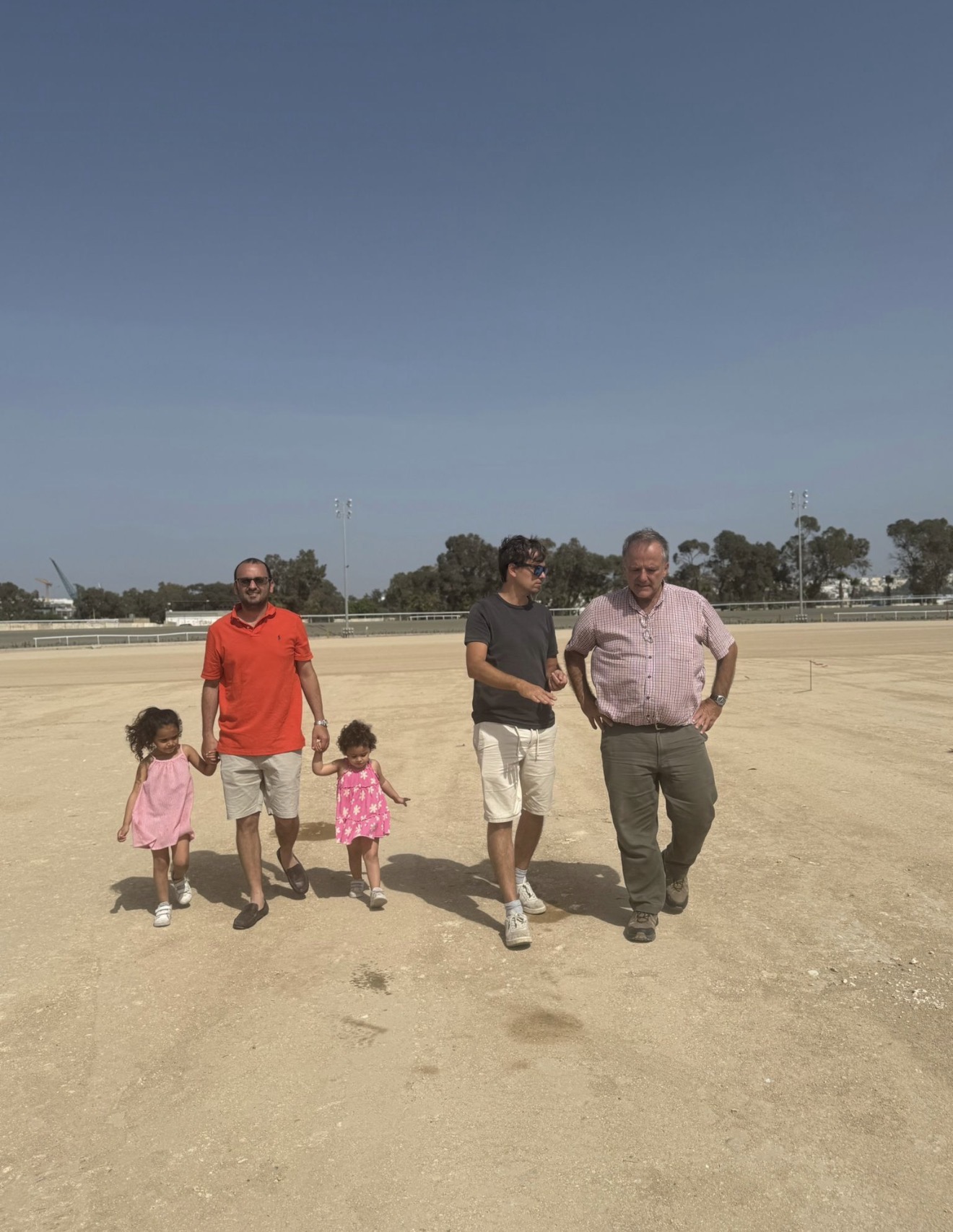
Simon Psaila, now club president, and his two children with Jeremy Besancon and Ignacio Martínez Sarrasague of Battro Polo Fields during one of Ignacio’s early visits to Marsa.
What Battro found beneath the pitch
In its written clarifications, Battro recalled an agreement to lay and compact the fill in layers of 20 cm. It reported that the layers actually laid were 70 cm to 1.40 m thick. Large rocks left gaps in the fill, making it difficult to compact. Battro called on the developer or contractor to consult a soil mechanics specialist about the risk of the ground settling.
The same document set out the order of work. The slope had to continue beyond the sideboards so water could reach the drains. Irrigation was to go in after the soil and sand had been levelled and before the grass was sown.
Clarifications, December 2025, pp. 1–2.
What Battro specified for the playing surface
In Report No. 4, Ignacio Martínez Sarrasague and Alejandro Battro updated an earlier report. They proposed a 10 cm surface layer made of 70% silica sand, 15% stone-free local soil and 15% organic material. They recorded that the contractor had raised the possibility of using the soil from the lower layers at the surface and explained why that soil was unsuitable there.
Battro also asked for the survey readings for the lower soil layer, B2. The engineers had been told its levels were acceptable and were still waiting for the measurements. They also requested the laboratory analysis of the available irrigation water.
Polo Field Construction, Report No. 4, May 2026, pp. 1–4.
Set out the ground and its run-off
A full-sized boarded field in the Hurlingham rules measures 300 by 160 yards, about 275 by 146 metres. The rules recommend clear run-off of 10 yards at the sides and at least 30 beyond each end. The Marsa concession requires FIP conformity and at least the existing playing area. Battro recommends the same soil and grass in the safety areas as on the field.
Survey each layer before covering it
First establish levels and falls so water can leave the field. Battro called for a grid of survey points tied to a fixed reference. At each stage, check the material, the finished thickness and the level across that grid. An error buried under the next layer is difficult to put right.
Establish turf before the first chukka
Plan drainage and irrigation together. The root zone needs enough water for grass to grow and enough open space for surplus water to drain. Establish the grass, allow roots to bind the surface, then assess cover, firmness, grip and moisture across the pitch and run-off before scheduling fast play.
The proposed soil profile
From the grass down · depths after compaction
At the surfaceTifton 419
The club’s preferred turf for its single main pitch. After planting, add thin dressings of suitable stone-free silica sand as the turf develops, following the agronomist’s programme.
Upper 10 cm · layer AThe root zone
70% silica sand, 15% good local stone-free soil and 15% organic substrate in Battro’s proposed mix.
Next 18 cm · layer B1Loam or sandy soil
Stone-free material with a balance of sand, silt and clay, low salt content and controlled levels.
Lower layers · B2 and CSupporting ground
Lower loam or sandy soil over natural subsoil, with the top of B2 set 28 cm below the finished level.
Battro Polo Fields, Marsa Polo Field Construction, Report No. 4, May 2026, pp. 2–3. The engineers based this proposal on the materials then available. For the Tifway 419 recommendation, see Battro’s October 2022 report, p. 2. About Battro